We may earn a commission from links on this page.
Key takeaways
- Switch off the ceiling light during films; overhead light washes out the picture and reflects in the screen.
- Add bias lighting behind the TV, set dim (about 10 percent of the screen's brightness) to cut eye strain and make blacks look deeper.
- Keep room light warm, around 2700K, and place every source beside or behind the seats, never facing the screen.
- Use the black-screen test to find reflections before the movie starts.
- Set up three simple light scenes: pre-show, movie and intermission.
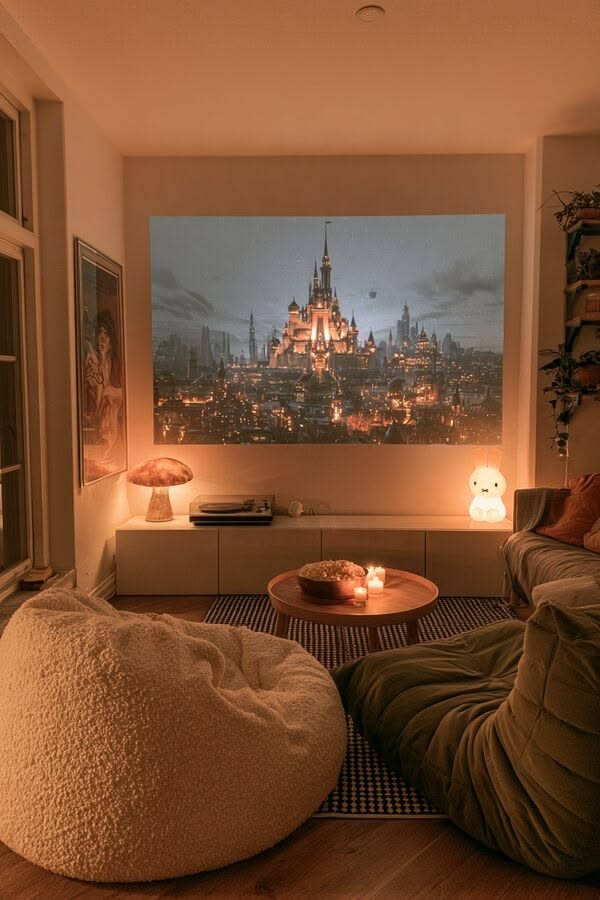
The coziest TV rooms on Pinterest share one thing: they glow. Picture a film projected large on a warm wall, a mushroom lamp casting a pool of amber light, a single candle on a round wood table and two oversized bean bags sinking into the shadows. Nothing is bright, yet you can see everything you need to.
That look isn't an accident. Good TV room lighting is about placing small amounts of the right light in the right places, so the room feels warm and the picture still looks its best. Most lighting guides stop at pretty photos. This one explains the why and gives you the settings, distances and order to set it up.
Why the ceiling light ruins movie night
A ceiling light does two things you don't want while watching. First, it lands on the screen and reflects back at you, showing up as a bright patch during dark scenes. Second, it lifts the light level of the whole room, which makes the picture's blacks look grey and its colors flat. Your eyes adjust to the brightest thing in the room, and when that's a ceiling fixture, the TV has to compete.
The opposite extreme, total darkness, isn't ideal either. Watching a bright screen in a pitch-black room makes your pupils work constantly as scenes change from dark to light, which is tiring over a two-hour film. The goal is a dim room with soft light coming from behind the screen and from the sides.
Bias lighting: the single best upgrade
Bias lighting is a strip of light on the back of the TV that shines onto the wall behind it. It gives your eyes a steady reference point, which reduces strain, and it makes the picture's dark areas look deeper by contrast. It is also what gives a TV wall that soft halo you see in cozy room photos.
For the best result:
- Keep it dim. A common guideline is around 10 percent of the screen's brightness. If you notice the light rather than the film, it's too bright.
- Choose the color by goal. Neutral white is the most accurate choice for picture quality; a slightly warmer white feels cozier. Avoid strong colors during films, since they tint how you perceive the picture.
- Mount it 2 inches in from the edges of the TV's back panel, so the glow spreads evenly without showing a hard line around the frame.
- Power it from the TV's USB port where possible, so it can switch on and off with the TV on many models.
A TV LED backlight strip sized for 55 to 65-inch TVs covers all four sides with a 5-meter strip, and the remote and Bluetooth app make it easy to set a white tone and dim it for movies, then switch to a fun color for game nights.

TV LED Backlight Strip (55–65" TVs)
A 5-meter USB backlight kit for 55 to 65-inch TVs, adjustable by remote or Bluetooth app, for a soft glow that reduces eye strain.
$26.99 · Free shipping
Buy Now — $26.99Ambient light: warm, low and to the side
Ambient light fills the rest of the room so it doesn't feel like a cave. Choose warm white, around 2700K, for lamps and decorative lights. Cooler light, 4000K and above, feels more like an office and clashes with the warm tones of a cozy room.
Placement matters more than the fixture. Anything glowing on the wall opposite the screen, or directly behind the seats at screen height, will appear as a reflection. Put lights on the side walls, low on shelves or in corners, and use opaque shades on lamps, so the light falls down rather than out.
Warm white fairy curtain lights are ideal for this layer. Hang the 9.8 by 9.8-foot curtain on a side wall, in a corner or in a window to the side of the screen, and run it on the steady setting at low brightness during the film. The twinkle and wave modes are fun for the pre-show and for parties.

Warm White Fairy Curtain Lights (300 LED)
300 warm white LEDs on a USB-powered curtain, with a remote and 8 modes, for a soft ambient glow on side walls and windows.
$45.99 · Free shipping
Buy Now — $45.99Accent light: candles at different heights
Accent light is what makes a room feel intimate. A few small sources at different heights catch the eye and make the space feel layered. Candles are the classic choice, but with throws, cushions, children and pets around, a flame near a TV seating area is a real risk.
Flameless LED pillar candles solve that. Group the three pillars on a side table, the floor beside a bean bag or one end of the console, at least a couple of feet from the screen so their flicker doesn't distract. The remote lets you dim or switch them off from your seat, and the timer turns them off after four or eight hours.

Flameless LED Pillar Candles, set of 3
Three real-wax pillars with flicker effect, remote and 4- or 8-hour timer for safe candlelight next to cushions and throws. Batteries are not included.
$49.99 · Free shipping
Buy Now — $49.99Give your candles a base. A round acacia wood serving tray on the coffee table makes a small grouping look deliberate, and the warm wood picks up the amber tone of the light. It's 8.7 inches across, so it suits one candle and a small object or a single mug.

Round Acacia Wood Serving Tray
A compact 8.7-inch acacia tray that turns a candle or a mug into a neat little vignette on any table.
$47.99 · Free shipping
Buy Now — $47.99Quick color temperature guide
Color temperature is printed on most bulb and light-strip boxes in kelvin (K). Lower numbers look warmer and more golden; higher numbers look whiter and bluer. Here is how each range behaves in a TV room:
| Color temperature | How it looks | Best use in a TV room |
|---|---|---|
| 2200K to 2700K | Golden, candle-like | Candles, fairy lights, lamps for movie nights |
| 3000K | Soft warm white | General lamps when you also read or play games |
| 4000K | Neutral, bright | Kitchens and work areas, not the TV room |
| About 6500K | Cool daylight white | Bias lighting when picture accuracy matters most |
The simple rule: warm for the room, neutral behind the screen, and nothing bright in between.
Find and fix reflections before you press play
The quickest way to check your lighting is the black-screen test. Switch the TV off, turn on your movie lighting and sit in each seat. Anything you see in the black screen will appear during dark scenes. Then fix it:
- Move the light a few feet to the side or lower it below the screen's reflection line.
- Dim it or switch it to steady if it's a twinkling light.
- Cover windows facing the screen, especially in the evening, when a dark window acts like a mirror.
- Angle the TV slightly if your wall mount tilts or swivels.
Set three simple light scenes
You don't need a smart home to have lighting scenes. Remotes, a dimmer or a couple of smart plugs are enough. Plan three settings:
- Pre-show: fairy lights in a gentle mode, candles on, a lamp at half brightness. Bright enough to find seats and snacks.
- Movie: bias light dim, fairy lights steady and low, candles dimmed or off, lamp off.
- Intermission: lamp back on low so people can move around safely, everything else unchanged.
Practice the switch once. When the change from pre-show to movie takes five seconds instead of a scramble for switches, the room feels like a real cinema.
Finish with comfort
Lighting creates the mood, but comfort keeps people in it. Keep a chunky knit throw blanket on every seat; in a dim room, the soft texture is part of what makes the space feel inviting.

Chunky Knit Throw Blanket, grey
A soft chenille cable knit in grey, 51 x 63 inches, that adds warmth and texture to a low-lit TV room.
$62.99 · Free shipping
Buy Now — $62.99Shop the look
Everything used in this setup, in one place. Shipping is free on every item.
- TV LED Backlight Strip (55–65" TVs) — $26.99, free shipping Buy Now
- Warm White Fairy Curtain Lights (300 LED) — $45.99, free shipping Buy Now
- Flameless LED Pillar Candles, set of 3 — $49.99, free shipping Buy Now
- Round Acacia Wood Serving Tray — $47.99, free shipping Buy Now
- Chunky Knit Throw Blanket, grey — $62.99, free shipping Buy Now
The missing piece: what will you actually watch?
Your lighting now makes every film look better and every evening feel warmer. Now make sure there's always something good to watch.
Most homes now juggle several apps, each with its own login and its own monthly bill, and a good part of every movie night goes to scrolling, signing in and wondering which service has the film. A simpler route is one device with the streaming already included.
HD Streaming Box + 1 Year of Streaming included — $119, one payment.
One purchase covers the box and a full year of streaming, so there is no separate monthly bill to track for that first year.
- Plug it into HDMI on your TV or projector.
- Connect it to Wi-Fi.
- Press play.
Checklist
- Ceiling light off during the film
- Bias light fitted 2 inches from the TV edges, set dim
- All room lights warm white, about 2700K
- No light source on the wall facing the screen
- Black-screen test done from every seat
- Windows facing the screen covered
- Candles at least a couple of feet from the screen, timer set
- Pre-show, movie and intermission scenes planned
Frequently asked questions
Is it better to watch TV in the dark?
Not completely. A dim room with soft light behind the TV is easier on your eyes than total darkness, and the picture still looks deep and rich.
What color should TV backlighting be?
Neutral white is the most accurate for picture quality. A slightly warmer white is a cozy compromise. Save strong colors for parties and gaming.
How bright should bias lighting be?
Dim. A common guideline is about 10 percent of the screen's brightness. If the light catches your attention during the film, turn it down.
Where should lamps go in a TV room?
To the sides of the seating or behind it, below screen height, with opaque shades. Avoid the wall opposite the TV, where lamps reflect in the screen.