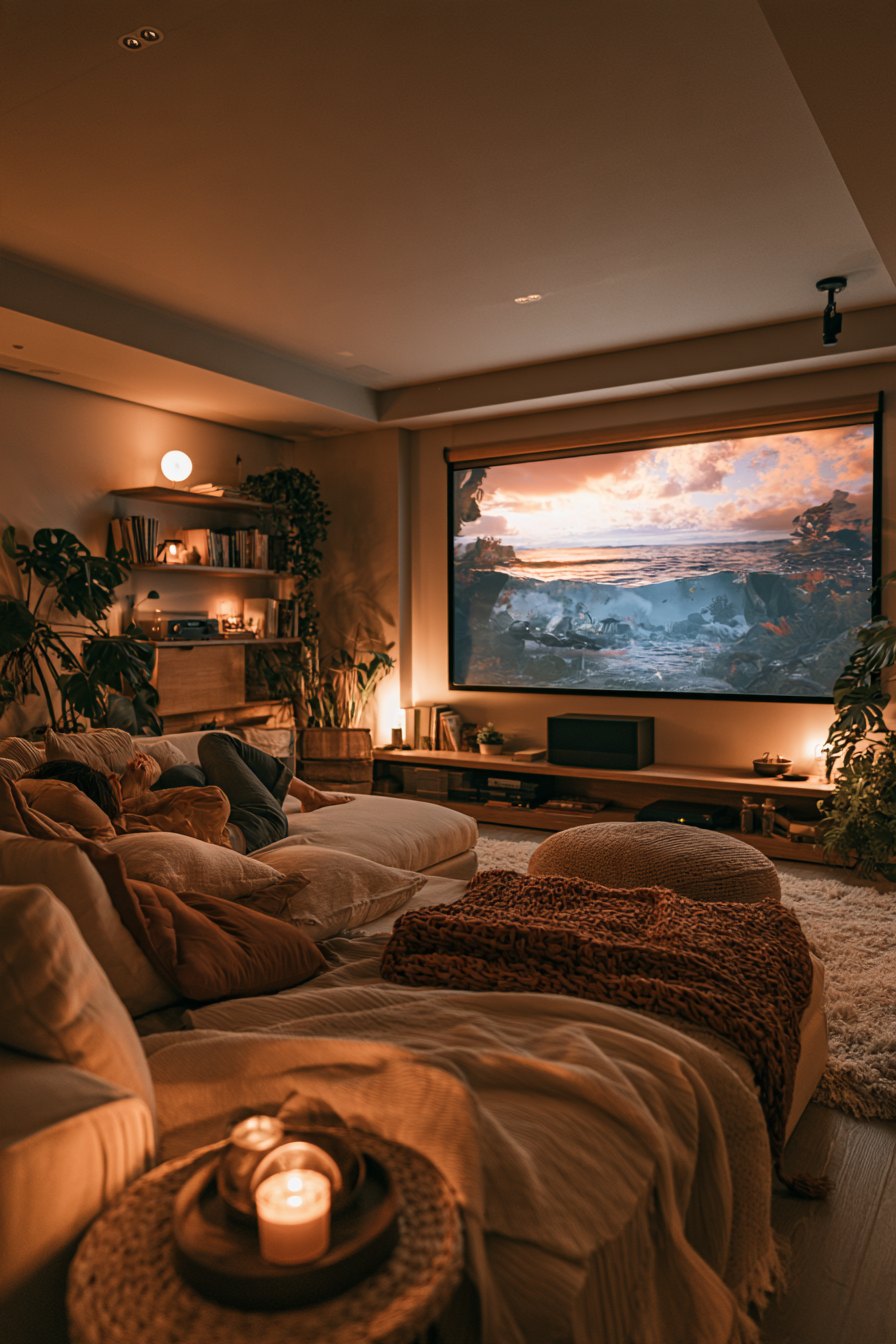
Your basement is the most underused room in the house, and it might also be the best candidate for a home theater you will actually use every night. Low natural light, solid walls that dampen sound, and separation from the rest of the house make a basement a natural fit. The challenge is turning a concrete box into a space that feels warm, purposeful, and worth sitting in for a three-hour movie or a back-to-back game day.
Start With the Right Screen and Projector Size
Rule of thumb: seat your viewers at a distance of 1.5 to 2.5 times the diagonal screen width. A 120-inch screen pairs well with seating 15 to 25 feet back. For a typical basement rec room that runs 20 to 25 feet deep, a 100- to 120-inch projector screen or a 85- to 98-inch flat-panel TV covers the range comfortably. If you choose a projector, look for at least 2,500 lumens for a room you can fully darken, or 3,500+ lumens if any ambient light sneaks in. Mount the projector on the ceiling 10 to 14 feet from the screen to avoid keystoning without heavy correction.
Sound: The Detail Most People Skip
Good sound does more for immersion than any screen upgrade. A 5.1-channel system — two front speakers, a center channel, two surround speakers, and a subwoofer — is the entry point for a true theater feel. Place the center channel directly below or above the screen at ear level when seated. Position surround speakers 2 to 3 feet above ear level and roughly 90 to 110 degrees to the sides of the primary seat. Keep the subwoofer in a front corner to reinforce bass response. Acoustic panels on bare drywall cut flutter echo noticeably; even four 2×4-foot panels on the side walls make dialogue crisper.
Seating Layout and Comfort
Tiered risers are a weekend project that pays back for years. A single 8-inch riser in the rear row gives everyone a clear sightline over the front-row heads. Allow at least 48 inches of row depth per seat row so recliners can fully extend without hitting the row in front. Standard recliner width runs 28 to 32 inches, so a 12-foot-wide basement can fit four recliners side by side with a small aisle gap. Leather and microfiber both clean well; microfiber tends to feel warmer in a basement that runs cool.
Lighting That Sets the Mood
Overhead cans are the enemy of ambiance. Swap them for dimmable LED strip lights tucked behind the screen frame, under risers, and along stair nosings — anywhere that adds depth without shining in anyone's eyes. Warm white (2700K) on the walls and cool white (5000K) behind the screen creates a subtle bias lighting effect that reduces eye strain during long sessions. A simple smart dimmer lets you set the room to full bright for setup, half for pre-show socializing, and near-dark for viewing, all from one app or remote.
The Content Problem No Setup Solves on Its Own
Here is where beautiful rooms hit a wall. You build the space, calibrate the picture, dial in the sound — and then you cycle through four different streaming apps looking for the game that is not carried on your local affiliate, the film that rotated out of the catalogue you pay for, or the channel your family actually wants on a Tuesday night. That friction — four apps, four bills, still missing something — is exactly the kind of problem a single service carrying both live channels and a deep on-demand library is designed to fix. Many households that run into that wall land on Ovelo TV as a way to consolidate without giving anything up.
Choosing the Right Streaming Device
A 4K-capable streaming stick or box on your TV handles most apps fine, but if your library includes live channels alongside on-demand content, make sure the device supports the app or platform you use. HDMI 2.1 ports matter if you are feeding a next-generation console through the same display. A universal remote that consolidates the TV, receiver, and streaming device inputs saves the "wrong remote" argument in the dark.
Putting It All Together
A cozy basement home theater does not require a six-figure renovation. A 100-inch screen, a 2,500-lumen projector, a 5.1 sound system, dimmable LED strips, and tiered seating can all be done thoughtfully for well under $5,000 if you prioritize and shop carefully. What matters at the end of the night is that everyone in the room found what they wanted to watch. For families who keep bumping into missing channels or disappearing titles, a unified streaming solution is often the last piece the room was waiting for.
Start with the screen size, work backward to seating distance, layer in sound and lighting, and finally solve the content side. When the room is right and the content is right, a basement stops feeling like storage space and starts feeling like the best seat in any theater — yours. If you are still sorting out the content side of the equation, take a look at what Ovelo TV offers before you commit to another stack of separate subscriptions.